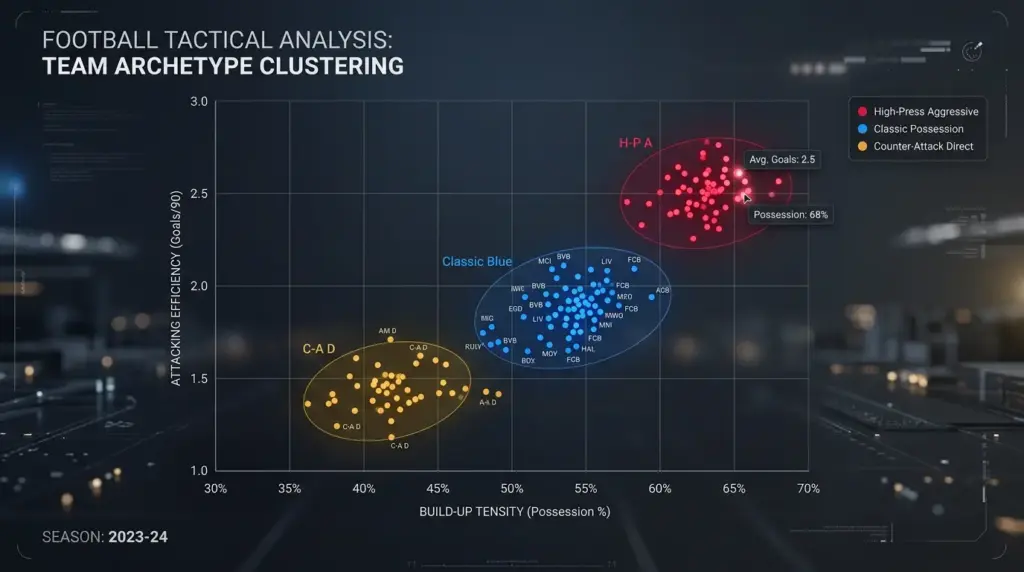
In the realm of advanced sports analytics, secondary betting markets like total match corners often yield a more sustainable mathematical edge than primary match-winner markets. While public money heavily gravitates toward fluctuating goal outcomes, corner lines remain anchored to rigid baseline averages that frequently fail to account for specific tactical friction points between opposing squads. Analyzing the 2012/2013 German Bundesliga through this localized quantitative lens reveals that corner production is not an arbitrary metric, but rather a direct structural consequence of a team’s attacking width, crossing frequency, and defensive clearing philosophies.
The Structural Drivers Behind High-Volume Corner Accumulation
A common misconception among casual sports bettors is that a high volume of goals naturally translates into a high volume of corners. In reality, teams that rely on intricate, vertical tiki-taka passing down the central channels, such as the tactical variants deployed by Borussia Mönchengladbach during the 2012/2013 campaign, generate surprisingly few corners because their shots originate primarily within the width of the eighteen-yard box. True corner-producing engines are defined by an intentional reliance on traditional, dynamic wingers who aggressively push down the flanks to execute low or high crosses, intentionally forcing opposing fullbacks into desperate deflections past the goal line.
Mapping the Tactical Extremes of the 2012/2013 German Campaign
The 2012/2013 Bundesliga campaign highlighted a stark division between squads designed to create external spatial overloads and those built around compact internal mid-blocks. Jupp Heynckes’ dominant Bayern Munich squad represented the absolute pinnacle of high-volume corner production, heavily exploiting the overlapping partnerships of their world-class fullbacks and inverted wingers to continually trap opponents deep within their own defensive thirds. Conversely, lower-tier clubs facing relegation pressure often opted for narrow, highly structured central low-blocks that actively surrendered outer territory while focusing entirely on congested penalty box defense, creating massive tactical imbalances perfect for over/under market analysis.
To systematically exploit the discrepancies built into bookmaker opening lines, analytical models must compare seasonal corner averages against the specific rates at which teams concede set pieces to their opponents. The statistical table outlined below isolates the four most distinct team profiles from the 2012/2013 season, providing the exact quantitative foundation required to separate high-probability over targets from consistent under selections.
| Bundesliga Club | Attacking Identity | Average Corners Won (Per Match) | Average Corners Conceded (Per Match) | Total Match Corner Average | Primary Over/Under Target |
| Bayern Munich | Elite Flank Overload | 7.12 | 2.85 | 9.97 | High Team Total Over |
| Bayer Leverkusen | Rapid Counter-Attack | 5.44 | 4.82 | 10.26 | Match Total Over |
| FC Augsburg | Direct Aerial Crossing | 4.91 | 5.38 | 10.29 | Match Total Over |
| Fortuna Düsseldorf | Deep Low-Block Defending | 3.41 | 6.24 | 9.65 | Individual Team Under |
Analyzing this historical dataset reveals that while Bayern Munich possessed an elite individual corner-generation rate, matches involving mid-table or lower-tier teams like FC Augsburg or Bayer Leverkusen frequently yielded a superior overall match total for over bettors. Augsburg’s high match total was driven not by dominant possession, but by an operational loop consisting of low technical efficiency, high crossing volumes, and a fragile defensive line that regularly conceded deflections. Recognizing these hidden statistical engines allowed systematic bettors to avoid the inflated lines of high-profile clubs while capturing continuous value on less popular fixtures.
The Mechanics of Flank-Based Attack Vectors
Deconstructing how wingers interact with defensive blocks provides the definitive causal mechanism for predicting highly specific corner outcomes during the pre-match analytical phase. When an attacking system prioritizes hitting the byline over cutting inside, the geometric probability of an opposing defender blocking a cross out of bounds escalates exponentially. Understanding these distinct micro-tactics allows sports modelers to accurately forecast corner spikes long before a ball is even kicked.
Winger Trajectory and Deflection Geometry
The ultimate generator of consistent attacking corners is the tactical deployment of a traditional winger playing on the side of their dominant foot, which forces them to cross the ball while running parallel to the baseline. This mechanical motion naturally directs the ball across the face of the goal at a sharp angle, meaning any lunging intervention from a tracking fullback is mathematically far more likely to redirect the ball out of play rather than clear it forward into the midfield zone.
When constructing a highly predictive corner-betting algorithm, analysts must actively look beyond simple team averages to verify whether situational match conditions will actually trigger high set-piece volumes. The operational checklist detailed below outlines the exact strategic factors that must align before confirming a high-confidence over position on a match total line.
- The favored team features starting fullbacks whose primary instructional mandate is to perform constant overlapping runs into the final third.
- The defending opponent employs an exceptionally narrow midfield diamond that structurally leaves the wide corridors completely undefended.
- The pitch dimensions of the hosting venue are historically narrow, which naturally compresses lateral play and forces rapid out-of-bounds deflections.
- The projected underdog possesses a physically imposing central defense that prefers headed clearances over controlled possession build-ups from the back.
Evaluating this synthesis of micro-data points demonstrates that corner production is an intensely structural phenomenon that can be systematically mapped out in advance. If a data model isolates a fixture where an elite flank-heavy team encounters a defensively stubborn but narrow opponent, the structural probability of the match surpassing the standard bookmaker line of 9.5 or 10.5 corners increases dramatically, irrespective of the projected scoreline.
Why In-Play Scenarios Invalidate Pre-Match Line Predictions
While pre-match statistical distributions offer an excellent baseline, the actual real-time generation of corners is profoundly dictated by the evolving game state and current scoreboard reality. A heavy pre-match favorite that scores two early goals will instantly drop their attacking intensity and shift into a low-risk possession cycle, completely drying up their corner production for the remainder of the match. Conversely, an elite team that unexpectedly falls behind by a goal at halftime will unleash an unrelenting wave of high-line wide attacks, generating a massive surge of second-half corners that completely shatters the initial pre-match market expectations.
Because these in-play fluctuations happen with intense speed and extreme volatility, smart sports operators utilize advanced technological infrastructure to secure real-time mathematical advantages. Observation of dynamic line movements implies that executing your positions through an established sports betting service such as ufa ufabet เว็บตรง provides the lightning-fast bet confirmation and deep live-market liquidity required to capitalize on game-state shifts before the bookmaker algorithms can recalculate the odds. Accessing highly stable live interfaces allows data-driven analysts to wait until the exact sixty-minute mark to strike, precisely when the trailing favorite’s desperation maximizes the geometric probability of rapid corner accumulation.
The Pitfalls of Analytical Anchoring to Basic Goal Metrics
A significant structural trap that consistently catches amateur bettors in the secondary markets is the cognitive bias of assuming that high-scoring teams are universally good over-corner targets. During the 2012/2013 campaign, certain high-scoring German teams relied heavily on central combination plays and rapid counter-attacks through the middle of the pitch, which resulted in highly efficient goals but remarkably low corner counts. Anchoring a corner model to simple goals-scored data introduces profound skew, leading to catastrophic losses if the modeler fails to isolate the exact spatial zone from which a team’s attacking actions originate.
To maintain perfect long-term portfolio stability, professional sports analysts intentionally separate their specialized prop-market models from the general financial metrics used to govern traditional sports wagering accounts. Many sharp algorithmic traders regularly audit their asset distribution by comparing their sports models to the mathematical risk models utilized inside a high-volume international casino online website to ensure proper standard deviation controls are maintained. By treating each individual corner line as a distinct probability matrix insulated from external media narratives, analytical bettors can execute a high-volume trading strategy that thrives on the predictable mechanical movements of professional football squads.
Summary
Analyzing the 2012/2013 Bundesliga season confirms that corner markets provide a highly sustainable, data-driven arena for bettors willing to look past basic outcomes and focus intensely on tactical architecture. Success in this specialized field requires isolating flank-dominated attacking systems, understanding the deflection geometries of defensive low-blocks, and constantly tracking live scoreboard realities that force dramatic shifts in in-play attacking desperation. By rigidly categorizing teams into specific tactical archetypes and ignoring the irrelevant noise of goal scoring, sports analysts can systematically expose the structural inefficiencies inherent within rigid bookmaker set-piece lines.
Leave a Reply